What Is a Test Match in Cricket? The 5-Day Format
On this page10
- 01What is a Test match in cricket?
- 02How many overs are in Test cricket?
- 03How many hours are played each day?
- 04Test match rules at a glance
- 05How a Test is won, drawn or tied
- 06What is the follow-on?
- 07Which teams have Test status?
- 08What is the World Test Championship?
- 09What is a day-night Test?
- 10Why is it called a “Test” match?
A Test match is cricket’s five-day international format: two innings per side, no limit on overs, and a draw if neither team finishes the job in time. It is played only between the 12 nations that hold Full Member status with the ICC, and it is the format the sport treats as its highest standard. The five-day limit rather than an overs limit is what makes it behave unlike anything else in cricket. The format also creates long statistical races, including the most runs in a Test series, the highest individual Test score, India’s most Test runs, the most expensive over in Test cricket, how many wickets are in cricket and the basics of cricket fielding positions.
What is a Test match in cricket?
A Test is a match of five days’ scheduled duration between two Test-playing countries, in which each side bats twice. To win, a side must take 20 wickets and finish with more runs.
That is harder than it sounds, because there is no innings limit to force the issue. A side can bat for two full days if it wants to. The ICC’s Test playing conditions set the duration at five days and leave the rest to the captains, which is why declarations and follow-ons become tactical weapons.
| Test | ODI | T20I | |
|---|---|---|---|
| Duration | 5 days | 1 day | About 3 hours |
| Innings per side | 2 | 1 | 1 |
| Over limit | None | 50 | 20 |
| Per-bowler cap | None | 10 overs | 4 overs |
| Draw possible | Yes | No | No |
| Ball | Red, or pink for day-night | White | White |
The contrast with the limited-overs game is set out in more depth in our guide to how many overs an ODI has.
Pakistan’s upcoming Tests are listed alongside limited-overs fixtures on its permanent team schedule. The India men’s schedule uses the same fixed-URL model and keeps a five-Test home series against Australia separate from its ODI and T20I rows. The India Women’s schedule separately records the 270-run Lord’s win and the four-day South Africa Test. Australia’s own men’s 2026-27 schedule shows how its Tests fit into a 20-Test calendar, while the Australia Women’s schedule keeps its red-ball matches separate from white-ball entries. The England men’s schedule separately tracks 13 Tests, while the England Women’s schedule keeps the same Ashes Test distinct from the six white-ball matches in that series. South Africa’s men’s schedule groups eight home Tests, and the South Africa Women’s schedule carries separate Tests against India and Australia. The New Zealand schedule carries eight Tests across its India, Australia and Sri Lanka series, the Sri Lanka schedule separates two recent results from four upcoming Tests, and the Bangladesh schedule keeps five exact Tests apart from tentative WTC windows.
For venue-level 2027 planning, compare the confirmed and still-unannounced details in the guides for Lord’s, Trent Bridge, Edgbaston, the Kia Oval, Utilita Bowl, Emirates Old Trafford, Headingley, Vidarbha Cricket Stadium, Barsapara Cricket Stadium, JSCA International Stadium, Narendra Modi Stadium, Bay Oval and Seddon Park. The venue pages label whether a match is a Test, ODI, T20I or a conditional warm-up rather than treating every listed event as a Test.
How many overs are in Test cricket?
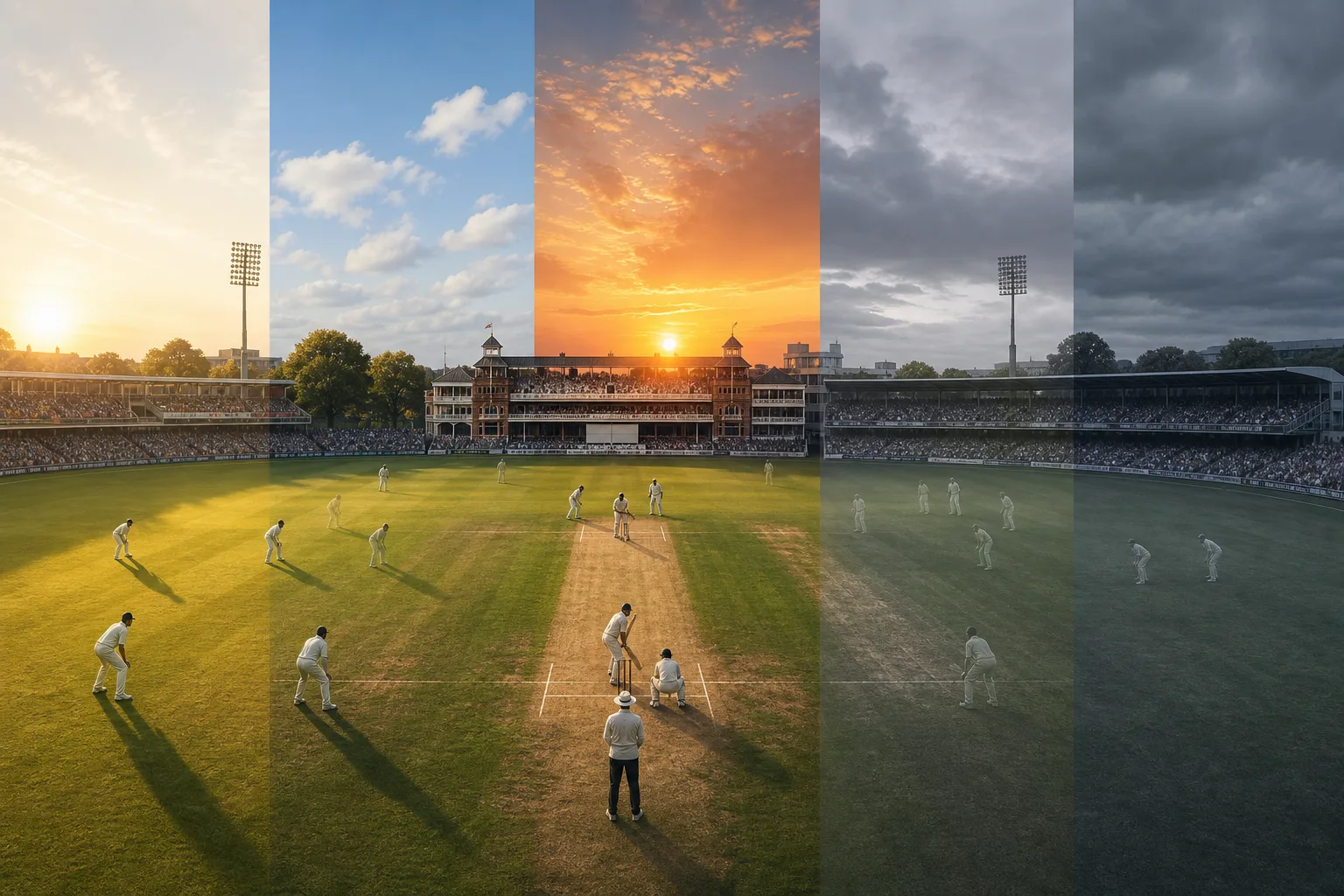
There is no fixed total number of overs in a Test match and no over limit on either innings. A team keeps batting until it is dismissed, declares or forfeits. The 90-over figure people often quote is a daily minimum target, not an innings cap and not a promise that a five-day match will contain exactly 450 overs.
In a full, uninterrupted match, days one to four each target at least 90 overs. Day five schedules 75 overs before the mandatory last hour, which has a minimum of 15 more. That produces a theoretical scheduled minimum of 450 overs across five days, but the actual total can be lower because of rain, bad light, slow play, declarations or an early result. It can also exceed 450 when overs are completed quickly or play is extended under the conditions.
How many hours are played each day?
Six hours of scheduled play per day, and a minimum of 90 overs on each day other than the last. The minimum over rate is 15 overs per hour.
On the final day the minimum is 75 overs plus a mandatory last hour, in which at least 15 more overs must be bowled. Play can be extended up to 30 minutes beyond the scheduled close to complete the day’s overs, and any overs still missing are not carried over. Since June 2025 a stop clock applies in Tests: the fielding side has 60 seconds to be ready for the next over, and a third breach in an innings after two warnings costs five penalty runs.
The day is split into three sessions of roughly two hours, broken by lunch and tea. A new ball becomes available to the fielding captain once 80 overs have been bowled with the old one.
Test match rules at a glance
| Rule | What it means |
|---|---|
| Match length | Up to five days, normally six scheduled hours per day |
| Innings | Two per team; an innings has no over limit |
| Overs | Six legal balls; target of 90 per full day before the final day |
| Bowling limit | No individual bowler cap |
| New ball | Available after 80 overs with the current ball |
| Declaration | A captain may close the team’s innings before all ten wickets fall |
| Follow-on | A side leading by at least 200 after the first innings may make its opponent bat again |
| Result | Win, draw or tie; abandonment can also produce no result |
The same basic Laws govern every format, but ICC Test playing conditions set the schedule and format-specific details. Weather can reduce the day’s target, and overs not completed after permitted overtime are not automatically carried into the next day.
How a Test is won, drawn or tied
A Test is won when one side is dismissed twice and the other has scored more runs. That makes wicket-taking rules—especially decisions such as leg before wicket (LBW)—central to the format. Everything else follows from what happens when that does not occur inside five days.
A draw is the result when time runs out with innings unfinished. It is not a failure state: a side eight wickets down and 300 behind at the close has successfully saved the match. A tie is different and vanishingly rare, requiring all four innings to be completed with the scores exactly level. Only two have occurred in Test cricket as of 2026: Australia against West Indies at Brisbane in 1960, and India against Australia at Madras in 1986.
Captains have two tools to manufacture a result. A declaration closes an innings voluntarily, giving up runs to buy bowling time. A forfeiture gives up an innings entirely, which is legal but almost never used.
The extreme case came at Durban in March 1939, in the last of the timeless Tests. South Africa and England played on for ten days, 1,981 overs were bowled, and it was still abandoned as a draw because England’s ship home was due to sail.
What is the follow-on?
The follow-on lets the side batting first send the opposition straight back in. Law 14 sets the threshold at a lead of at least 200 runs in a match of five days or more.
It is an option, not an obligation, and modern captains often decline it. Enforcing the follow-on means the bowlers go straight back out without a rest, and the side that follows on bats last on a deteriorating pitch only if it survives. Only three sides have won a Test after being asked to follow on, as of 2026. The thresholds scale with match length: 150 runs in a three or four-day match, 100 in a two-day match and 75 in a one-day match. Our dedicated explainer on what the follow-on is in Test cricket covers the tactical arguments in full.
Which teams have Test status?
Twelve nations hold Test status, and it comes bundled with Full Membership of the ICC rather than being awarded separately.
The twelve are Australia, Bangladesh, England, India, Ireland, New Zealand, Pakistan, South Africa, Sri Lanka, West Indies, Zimbabwe and Afghanistan. Afghanistan and Ireland were voted in unanimously at the ICC’s annual conference in London on 22 June 2017, the first expansion since Bangladesh in 2000. The distinction between Full Members and the 94 Associate Members is explained in our guide to what ICC stands for in cricket.
Not every Test nation plays every other regularly. Bilateral series are negotiated board to board, so Afghanistan, Ireland and Zimbabwe play far fewer Tests than the established nine.
What is the World Test Championship?
The WTC is the ICC’s attempt to give bilateral Test cricket a league table and a final. It runs on a two-year cycle and involves nine of the twelve Test nations, with Afghanistan, Ireland and Zimbabwe outside it. The current World Test Championship 2025-27 hub carries the official standings, PCT calculation and 2027 final status.
Each side plays six series, three at home and three away. A win is worth 12 points, a tie 6, a draw 4 and a loss 0, and teams are ranked by the percentage of available points won rather than the raw total, so a side playing 13 Tests in a cycle is not disadvantaged against one playing 22.
| Cycle | Final venue | Winner |
|---|---|---|
| 2019-21 | Southampton | New Zealand |
| 2021-23 | The Oval | Australia |
| 2023-25 | Lord’s | South Africa |
| 2025-27 | The Oval, June 2027 | To be decided |
South Africa’s five-wicket win over Australia at Lord’s in June 2025 was its first WTC title. The 2027 international cricket schedule places the next final’s confirmed 9-13 June window alongside that year’s other Tests without naming finalists before qualification is complete.
What is a day-night Test?
A day-night Test starts in the afternoon and runs into the evening under lights, using a pink ball because the red ball becomes difficult to pick up at dusk and the white ball dirties too quickly over long innings. Our guide to red, white and pink cricket balls explains how each colour fits its format.
The first was Australia against New Zealand at Adelaide Oval, beginning 27 November 2015, and Australia won it by three wickets inside three days. Roughly 25 men’s day-night Tests had been played as of mid-2026, so they remain occasional rather than standard. Players often report pronounced pink-ball movement around twilight, although conditions and the ball’s finish make a universal comparison with red-ball Tests unreliable.
Why is it called a “Test” match?
The name reflects what these matches were understood to be: a test of the relative strength of two sides, played over enough days that a single hour of luck could not settle it.
The label was applied retrospectively. The match now recognised as the first Test, Australia against England at the MCG from 15 March 1877, was billed at the time as a combined New South Wales and Victoria XI against James Lillywhite’s England professionals. Australia won by 45 runs, with Charles Bannerman making 165 before retiring hurt. The term only came into regular use in the 1880s, and Test status for those early games was assigned later.
Test cricket’s laws sit alongside every other format’s in our cricket rules hub. The beginner’s guide to what an innings means explains why a Test allows four team batting turns, while cricket abbreviations and full forms decodes the scorecard. England’s domestic four-day tradition is recorded in the complete County Championship winners list.
Long matches also create extended verbal contests between opponents. The guide to sledging in cricket separates tolerated competitive talk from conduct punishable under Law 42 and ICC codes. For related records and tournament context, see our guides to the fastest fifties in T20I cricket, Under-19 Cricket World Cup history and Women’s Cricket World Cup history.
Frequently asked questions
How long is a Test match?+
Five days, with six hours of scheduled play each day split into three sessions. A minimum of 90 overs must be bowled on each of the first four days and 75 on the last day, plus a final hour. Matches often finish inside the five days when a side is bowled out quickly.
Why can a Test match end in a draw?+
Because there is no over limit, only a time limit. To win, a side has to dismiss the opposition twice and score more runs. If the fifth day ends with wickets still standing, nobody has completed that task, so the result is a draw regardless of how far ahead one side was.
What is the difference between a draw and a tie in a Test?+
A draw means the match ran out of time with innings incomplete. A tie means all four innings finished with the scores exactly level. Draws are common; ties are extraordinarily rare, with only two in the history of Test cricket.
What is the follow-on in a Test match?+
If the side batting first leads by at least 200 runs after the first innings, its captain may ask the opposition to bat again immediately rather than batting second. The threshold drops to 150 runs in a three or four-day match, 100 in a two-day match and 75 in a one-day match.
How many teams play Test cricket?+
Twelve. They are Australia, Bangladesh, England, India, Ireland, New Zealand, Pakistan, South Africa, Sri Lanka, West Indies, Zimbabwe and Afghanistan. Afghanistan and Ireland were granted Full Member status in June 2017, taking the number from ten to twelve.
What is the World Test Championship?+
The WTC is the ICC's Test league, run over a two-year cycle with nine of the twelve Test nations taking part. Each side plays six series, three home and three away, and the top two on points percentage meet in a final. The 2025-27 final is scheduled for The Oval in June 2027.
What is a day-night Test?+
A Test played into the evening under floodlights using a pink ball, because a red ball becomes hard to see at dusk. The first was Australia against New Zealand at Adelaide Oval in November 2015. They remain occasional rather than routine, with roughly 25 played as of mid-2026.
Why is it called a Test match?+
Because the format was seen as a test of the relative strength of two sides, played over enough days to remove luck. The term was not used at the time of the first match in 1877, which was billed differently and only later given Test status. It came into regular use in the 1880s.
Sources
- ICC Men's Test Match Playing Conditions, effective June 2025
- MCC: Law 14, The Follow-On
- ICC: About our members (the 12 Full Members)
- ESPNcricinfo: Afghanistan and Ireland get Test status
- ESPNcricinfo: A brief history of pink-ball cricket
- ICC: Several changes made to ICC playing conditions (Test stop clock)
Related rules & terms guides
View all →
ODI Full Form in Cricket: Meaning, 50 Overs and Rules
ODI means One Day International. Learn its 50-over format, 300 balls, bowler limits, powerplays, DLS rain rules and 60-over history.

Cricket Abbreviations and Full Forms: The Complete List
Every cricket abbreviation and its full form: ODI, LBW, DRS, DLS, NRR, SR, ER, TBC, TBD, RSA, DNB, c&b, st and more, grouped by where you see them.

T20 World Cup Winners List 2007 to 2026: Every Champion
Complete T20 World Cup winners list from 2007 to 2026 with runners-up, hosts, final margins and players of the tournament, plus the women's champions.
What Is an Innings in Cricket? Meaning and Rules
An innings is one team's turn to bat, or one batter's time at the crease. Learn how innings work in Tests, ODIs and T20s and the five ways they end.
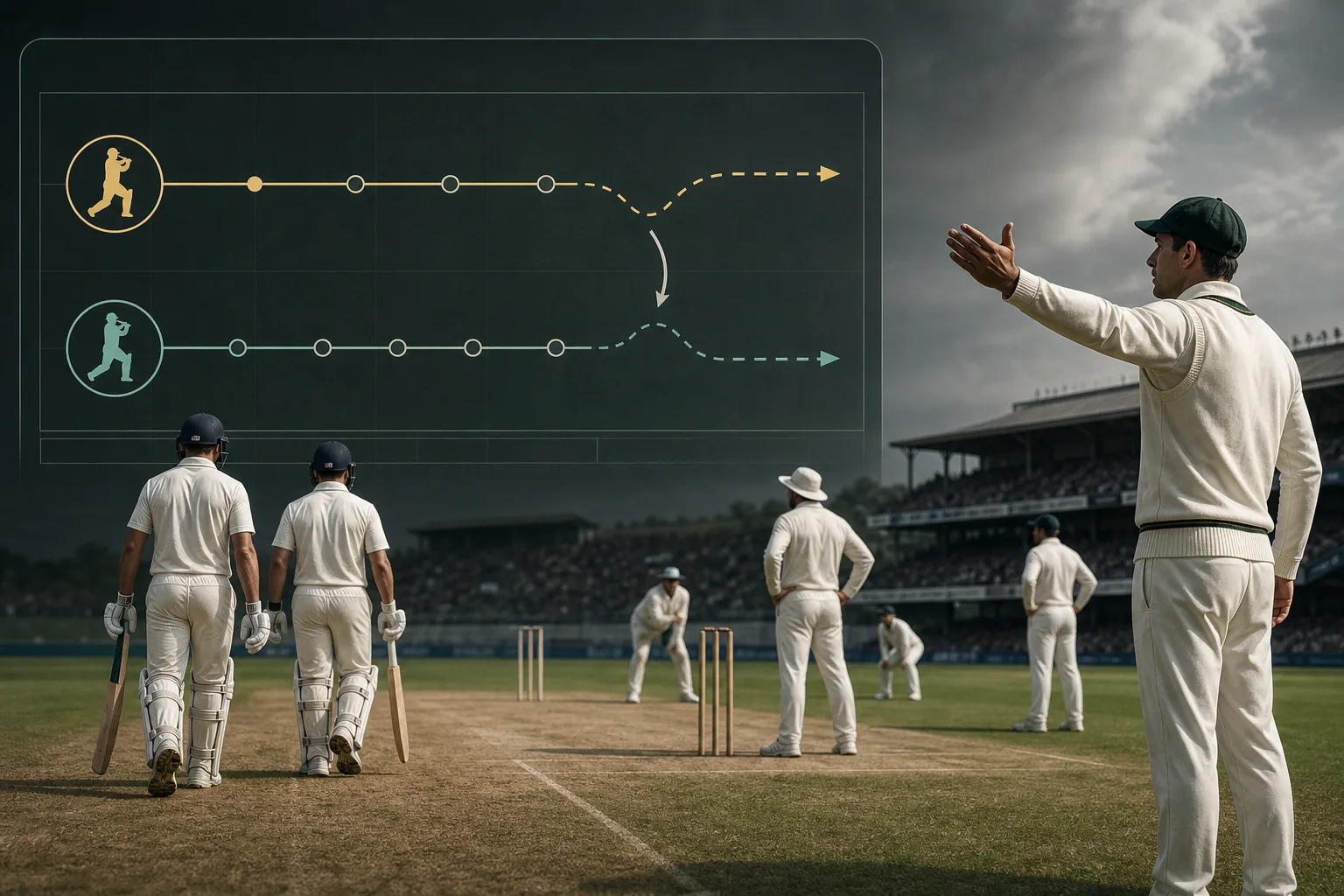
What Is the Follow-On in Test Cricket? Law 14 Explained
The follow-on lets a captain make the trailing side bat again. Here are the 200-run rule, the margins for shorter matches, and when enforcing it backfired.
ICC Full Form in Cricket: What It Stands For and Does
ICC full form in cricket is International Cricket Council, the global governing body based in Dubai. Here is what it runs and what it does not control.