What Is the Follow-On in Test Cricket? Law 14 Explained
On this page7
The follow-on is the option, under Law 14 of the Laws of Cricket, for the side that bats first to make its opponents bat again immediately rather than taking its own second innings. In a Test of five days or more the first-innings lead must be at least 200 runs. It is a choice the fielding captain makes, not something the umpires impose, and once announced it cannot be withdrawn. Readers following the rule in current series can find all 13 Tests on England’s 2026-27 team schedule.
What is the follow-on in Test cricket?
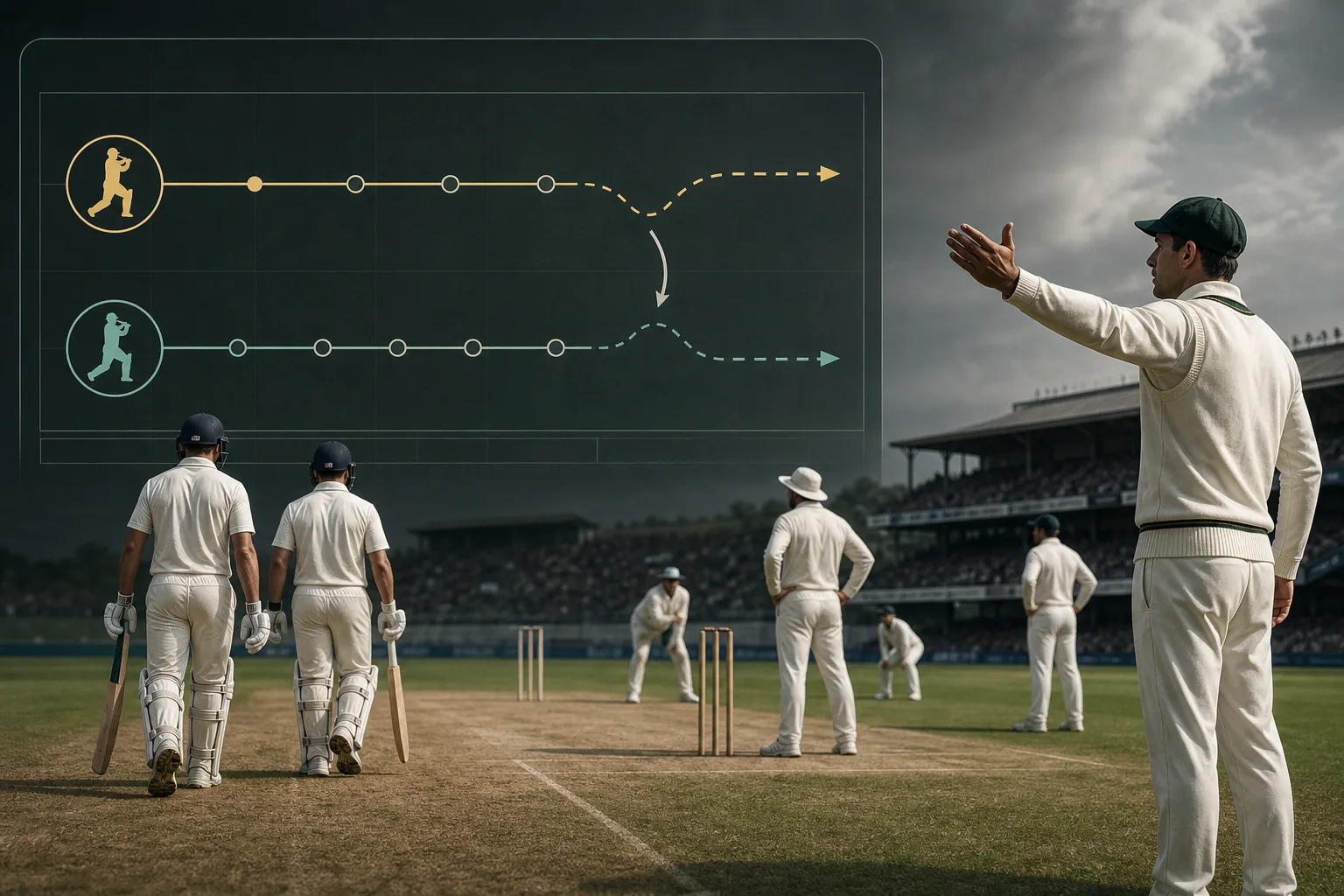
It is a way of pressing an advantage. Normally the innings alternate: side A, side B, side A, side B. Enforcing the follow-on breaks that pattern so side B bats twice in a row, which means side A can win without batting again at all and side B has to survive two long innings back to back on a wearing pitch.
The Law lives at Lord’s rather than with the ICC. MCC owns and drafts the Laws of Cricket, and the wording of Law 14.1.1 is blunt: a side leading by at least 200 runs in a match of five days or more “shall have the option” of requiring the other side to follow their innings.
How big does the lead have to be?
Two hundred runs in a Test, and less in shorter two-innings games. The threshold scales with match length because a shorter match gives less time to bowl a side out twice.
| Match length | Minimum first-innings lead |
|---|---|
| 5 days or more (Test cricket) | 200 runs |
| 3 or 4 days | 150 runs |
| 2 days | 100 runs |
| 1 day (two-innings) | 75 runs |
Two details catch people out. The lead is measured on first innings alone, so a side leading by 195 has no option however dominant the position looks. And Law 14.3 recalculates the whole table if weather intervenes: when no play takes place on the first day of a multi-day match, the thresholds apply according to the days remaining, so a five-day Test that begins on day two needs only a 150-run lead.
Is the follow-on automatic?
No, and this is where most explanations stop short. Law 14.2 requires the captain to notify both the opposing captain and the umpires of the intention to enforce it, and states that once notified, the decision cannot be changed. There is no window to reconsider after seeing the first few overs.
A captain who leads by 300 is under no obligation to do anything. Declining the follow-on is a normal, unremarkable decision in the modern game, and no side is penalised for it.
Why do captains increasingly decline it?
Three practical reasons, and none of them are sentimental. The first is bowler workload: asking a four-man attack to take twenty wickets across two consecutive innings, often in heat, risks injuries that carry through a series. The second is the pitch. Third-innings surfaces are usually easier to bat on than fourth-innings ones, so batting again and setting a target lets the bowlers attack on the worst pitch of the match rather than the second-worst.
The third is pure risk management. A side that bats again cannot lose. A side that enforces the follow-on can. Steve Waugh and Ricky Ponting both grew notably reluctant after 2001, Michael Clarke enforced it only once as Australia captain, and Andrew Strauss declined it repeatedly for England. The habit shifted from default to exception inside a single generation.
The four Tests won after following on
In nearly 150 years of Test cricket, only four sides have been asked to follow on and gone on to win. That is the statistic captains quote when they decline, and it cuts both ways: the odds are overwhelming, but the four exceptions are among the most famous matches ever played.
| Match | Venue and date | Result |
|---|---|---|
| Australia v England | Sydney, December 1894 | England won by 10 runs |
| England v Australia | Headingley, July 1981 | England won by 18 runs |
| India v Australia | Kolkata, March 2001 | India won by 171 runs |
| New Zealand v England | Wellington, February 2023 | New Zealand won by 1 run |
Headingley 1981 is the outlier of the group. England, following on and seven wickets down, were rescued by Ian Botham’s unbeaten 149, then Bob Willis took 8 for 43 as Australia collapsed for 111 chasing 130.
Kolkata 2001, the follow-on that changed captaincy
Australia arrived at Eden Gardens on 11 March 2001 with sixteen consecutive Test wins behind them. They made 445, Harbhajan Singh taking 7 for 123 including the first Test hat-trick by an Indian bowler, with Ricky Ponting, Adam Gilchrist and Shane Warne falling in three balls. Glenn McGrath then took 4 for 18 as India were bowled out for 171, and Steve Waugh enforced the follow-on with a lead of 274.
What followed was the defining innings of a generation. VVS Laxman made 281 and Rahul Dravid 180, adding 376 for the fifth wicket, and India declared on 657 for 7. Harbhajan took six more wickets as Australia were dismissed for 212, and India won by 171 runs on the final day. It remains the only time a side has declared its follow-on innings and won the match. Waugh’s decision was defensible on every piece of evidence available at the time, which is precisely why it made subsequent captains cautious.
Where the follow-on fits in the rulebook
The follow-on applies only to two-innings cricket, so it belongs to Tests and first-class competitions such as the County Championship. There is no equivalent in the 50-over format covered in our ODI overs guide or in T20, where each side bats once and a tie is settled by a Super Over rather than a second innings.
If you are new to the long format, our explainer on what a Test match is and how the five days work covers innings order, declarations and results. The ten ways a batter can be dismissed matter more here than anywhere else, because a captain enforcing the follow-on is betting on taking twenty wickets in a row. More rules of the long game are collected in our cricket rules hub.
Frequently asked questions
What is the follow-on rule in cricket?+
Under Law 14, a side that bats first and leads by at least 200 runs in a match of five days or more may require the opposition to bat their second innings immediately, instead of batting again itself. The lead is measured on first innings only.
How many runs are needed to enforce the follow-on?+
Two hundred in a Test of five days or more. Shorter formats scale down: 150 runs in a three or four-day match, 100 in a two-day match and 75 in a one-day match. The threshold is a minimum, so a lead of exactly 200 is enough in a Test.
Is the follow-on compulsory?+
No. Law 14 gives the captain an option, never an instruction, and modern captains decline it more often than not. Once the captain notifies the opposing captain and the umpires of the decision, however, it is locked in and cannot be changed.
Why do captains not enforce the follow-on any more?+
Mostly workload and pitch conditions. Bowling a side out twice in succession exhausts a four-man attack, and fourth-innings pitches usually offer more help than third-innings ones. Batting again also removes any chance of losing and lets a captain set a target rather than defend one.
How many teams have won a Test after following on?+
Four, in nearly 150 years. England beat Australia at Sydney in 1894 and at Headingley in 1981, India beat Australia at Kolkata in 2001, and New Zealand beat England at Wellington in 2023. Every one of them was a genuine escape rather than a planned strategy.
What happens to the follow-on if rain washes out the first day?+
Law 14.3 recalculates it. If no play takes place on the first day of a multi-day match, the thresholds apply according to the number of days remaining, so a five-day Test that starts on day two is treated as a four-day match and the requirement drops from 200 runs to 150.
Can a team declare its follow-on innings?+
Yes, and India did exactly that at Kolkata in 2001, declaring on 657 for 7 after being asked to follow on and then bowling Australia out to win by 171 runs. It remains the only occasion a side has declared a follow-on innings and won the match.
Does the follow-on exist in ODI or T20 cricket?+
No. The follow-on belongs to two-innings cricket, so it applies to Tests and to first-class matches such as county and Ranji Trophy games. Limited-overs formats give each side a single innings, which means there is no first-innings lead for a captain to act on and no second innings to enforce.
Sources
Related rules & terms guides
View all →
What Is a Test Match in Cricket? The 5-Day Format
A Test match is cricket's five-day format: two innings a side, no over limit, a draw if nobody wins. The rules, Test status and the WTC explained.

ODI Full Form in Cricket: Meaning, 50 Overs and Rules
ODI means One Day International. Learn its 50-over format, 300 balls, bowler limits, powerplays, DLS rain rules and 60-over history.

Can a Wicketkeeper Bowl in Cricket? The Rule Explained
Yes, a wicketkeeper can bowl in cricket. See how teams switch keepers, when substitutes cannot bowl, and what happens to the gloves and pads.

How Many Ways Can You Be Out in Cricket? All 10
All 10 ways a batter can be out under the MCC Laws, with Law numbers, how often each happens, and which dismissals actually credit the bowler.

What Is an Innings in Cricket? Meaning and Rules
An innings is one team's turn to bat, or one batter's time at the crease. Learn how innings work in Tests, ODIs and T20s and the five ways they end.

Cricket Abbreviations and Full Forms: The Complete List
Every cricket abbreviation and its full form: ODI, LBW, DRS, DLS, NRR, SR, ER, TBC, TBD, RSA, DNB, c&b, st and more, grouped by where you see them.