How Many Players in a Cricket Team? 11 on the Field
On this page8
- 01How many players are in a cricket team?
- 02Why 11 players?
- 03What the full squad looks like
- 04Team composition: what the 11 players do
- 05The 12th man and what a substitute may not do
- 06Concussion substitutes: the one substitute who plays fully
- 07The Impact Player rule in the IPL
- 08When a side ends up with fewer than 11
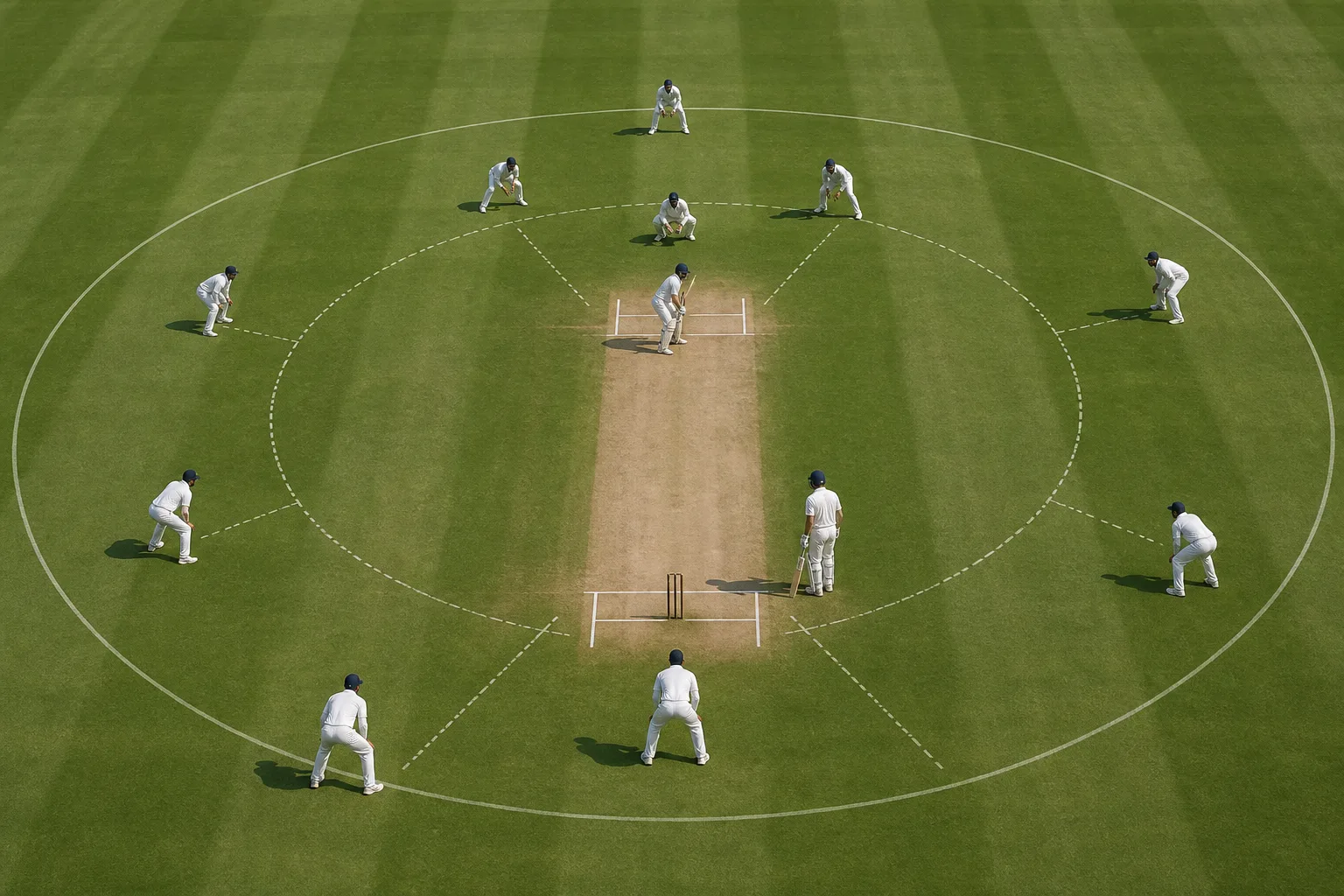
A cricket team has 11 players on the field. Law 1 of the Laws of cricket puts it directly: a match is played between two sides, each of eleven players, one of whom is captain. Sides may agree to field fewer or more in informal cricket, but no more than eleven may be on the field at any time. The squad behind those eleven is bigger, and the rules on who may replace whom are where the real detail sits. Smaller recreational formats such as box cricket set their own player counts and substitution rules.
How many players are in a cricket team?
Eleven take the field for each side, so 22 players are involved in the middle plus two umpires. One of the eleven is the captain and one is normally the wicketkeeper, although a nominated wicketkeeper can hand over the gloves and bowl. The bowler, wicketkeeper, and two batters work around the four crease lines marked at each end of the pitch.
The eleven is nominated in writing before the toss. In internationals, the ICC playing conditions require each captain to name the eleven plus a maximum of four substitute fielders to the match referee, and after that the eleven cannot be changed without the opposing captain’s consent.
Why 11 players?
Eleven is a convention that hardened into Law, not a number anyone calculated. Eleven-a-side matches are recorded in England from the late 17th century, well before the first written code of Laws appeared in 1744, and by the time the Laws were being codified the number was simply what everyone already played. Nothing since has given anyone a reason to change it.
It does happen to divide the work sensibly. Eleven gives you a keeper, four or five bowling options, an opening pair and enough of a middle order to survive a collapse. Take a player away and the fielding side runs out of bowlers; add one and the field gets crowded enough that scoring becomes difficult.
What the full squad looks like
The eleven is the match unit. The squad is the pool it is picked from, and squad sizes vary by competition.
| Level | Squad size | Notes |
|---|---|---|
| Playing eleven | 11 | Nominated before the toss |
| ICC event squad | 15 | The cap at the 2026 T20 World Cup, with changes needing ICC approval after the deadline |
| Test or ODI tour party | Usually 15 to 18 | Set by the touring board, not the ICC |
| Substitute fielders (internationals) | Up to 4 nominated | Fielding cover only |
| IPL franchise squad | 18 to 25 | Maximum 8 overseas, maximum 4 overseas in the eleven |
Team composition: what the 11 players do
The eleven is not eleven of the same thing. A conventional side splits into batters, all-rounders, a keeper and bowlers, and the mix shifts with the format.
| Role | Typical number | Batting positions | What they do |
|---|---|---|---|
| Openers | 2 | 1-2 | Face the new ball and the hardest bowling |
| Top and middle order | 3-4 | 3-6 | Build the innings; the No. 3 is usually the best batter |
| Wicketkeeper | 1 | 5-7 | Keeps to every ball; often bats in the middle order |
| All-rounders | 1-2 | 6-8 | Bat in the lower middle order and bowl a full share |
| Frontline bowlers | 3-4 | 8-11 | Take the wickets; the tail bats here |
In Test cricket sides usually pick four frontline bowlers plus an all-rounder, because they need 20 wickets over five days. In a 50-over game the constraint flips: no bowler may bowl more than 10 overs, so a side needs at least five bowling options to cover the 50, which is set out in our guide to how many overs an ODI has.
The 12th man and what a substitute may not do
The 12th man is the nominated reserve who fields when a member of the eleven leaves the field, and the restrictions on that role are strict.
Law 24 allows a substitute when a fielder is injured, becomes ill or has another wholly acceptable reason to be off. But the substitute may not bowl, may not act as captain, and may keep wicket only with the umpires’ consent. A substitute also cannot bat: the batting order belongs to the nominated eleven. If a batter is unable to bat, the side simply loses that wicket as absent hurt rather than sending in a replacement.
There is a time penalty attached in internationals. A player absent for more than eight minutes cannot bowl until they have been back on the field for as long as they were off, capped at 120 minutes of penalty time, and the same clock applies to batting.
Concussion substitutes: the one substitute who plays fully
A concussion replacement is the exception to everything above. Approved by the ICC match referee, they become a full member of the side and may bat, bowl and keep wicket.
The conditions are tight. The head or neck injury must happen during play, a concussion or suspected concussion must be diagnosed by the team medical representative, and the replacement must be like-for-like: a batter for a batter, a bowler for a bowler. The match referee weighs the likely contribution of the injured player against the normal role of the replacement, and can place restrictions on the replacement if the swap would give an unfair advantage. The replaced player takes no further part in the match.
Two things changed with the ICC’s 2025 playing conditions: teams must pre-nominate their concussion replacements before the match rather than picking anyone afterwards, and a concussed player faces a minimum seven-day stand-down before returning to play.
The Impact Player rule in the IPL
The Impact Player is a substitute who can bat or bowl, and it exists only in the IPL and a handful of other domestic T20 competitions. It is not part of international cricket.
Introduced in 2023, it lets each side name five substitutes alongside the playing eleven and bring one of them into the match. The swap has to be made no later than the 14th over of an innings, at the start of an innings, at the end of an over, at the fall of a wicket or when a batter retires. The player who is replaced takes no further part, not even as a substitute fielder, and the other four nominated substitutes remain fielding-only.
The overseas cap still binds. A team that starts with four overseas players in its eleven must use an Indian Impact Player; a team that starts with three or fewer can bring in a foreign one. The IPL Governing Council confirmed the rule would run through the cycle to 2027 despite objections from players who argue it squeezes out genuine all-rounders. If you want the competition context, our IPL winners list tracks how the format has changed alongside it.
When a side ends up with fewer than 11
A side can finish a match effectively short, and the Laws handle it without adding anyone. In recreational cricket, teams may agree on sides of fewer than eleven, and the fielding side simply covers more ground.
In internationals the eleven is fixed at the toss. If a player is injured mid-match, the side fields a substitute and bats one short. An innings still ends when ten wickets fall, or fewer if batters are absent, because the last remaining batter has nobody to run with. The methods by which those ten fall are covered in our guide to the types of dismissal in cricket, and the scorecard shorthand for a player who never got in is explained in cricket abbreviations and full forms.
Frequently asked questions
How many players are there in a cricket team?+
Eleven. Law 1 of the Laws of cricket states that a match is played between two sides of eleven players, one of whom is captain. Sides may agree to play with fewer or more, but no more than eleven may field at any one time in any format.
What is the 12th man in cricket?+
The 12th man is the nominated reserve who fields when someone in the eleven leaves the field. Under Law 24 a substitute may not bowl, may not bat and may not act as captain, and may keep wicket only with the umpires' consent. The role is fielding cover, not a full replacement.
Can a substitute bat or bowl in cricket?+
A standard substitute cannot. Law 24 restricts substitutes to fielding, with wicketkeeping allowed only if the umpires agree. The two exceptions are an approved concussion replacement, who plays as a full member of the side, and an IPL Impact Player under that competition's own playing conditions.
What is a concussion substitute in cricket?+
A concussion replacement is a like-for-like player brought in after a head or neck injury is diagnosed by the team doctor and approved by the ICC match referee. Unlike a normal substitute, they can bat, bowl and keep wicket. Since 2025 the replacements must be pre-nominated before the match.
How many players are in an IPL squad?+
An IPL franchise carries a squad of 18 to 25 players, of whom no more than eight may be overseas. Only four overseas players can be in the playing eleven at any point, which also caps who can come in as the Impact Player.
Can a cricket team play with fewer than 11 players?+
Yes, in the sense that a side short of players still bats and fields. In recreational cricket the Laws allow agreed sides of fewer than eleven. In internationals the eleven is nominated before the toss, and if a player cannot take part the side simply plays a man short rather than adding anyone.
Why does a cricket team have 11 players?+
It is a convention that hardened into Law rather than a calculation. Eleven-a-side matches are recorded in England from the late 17th century, so the number was already standard before the first written Laws appeared in 1744. It has never been changed for the main forms of the game.
How many players bat in a cricket innings?+
All eleven are in the batting order, but an innings ends when ten are out, because the last batter has no partner. Players who are not needed appear on the scorecard as DNB, did not bat. A retired hurt batter may return later in the same innings.
Sources
Related rules & terms guides
View all →
Cricket Fielding Positions Explained: A Simple Field Setup Guide
Learn every main cricket fielding position, where it sits relative to the batter and when captains use slips, point, cover, midwicket and the boundary riders.
How Many Wickets Are There in Cricket? Team, Innings and Pitch Explained
Cricket has two physical wickets, 10 dismissals to end a normal innings and 11 players in a side. Here is how each meaning fits together.
ODI Full Form in Cricket: Meaning, 50 Overs and Rules
ODI means One Day International. Learn its 50-over format, 300 balls, bowler limits, powerplays, DLS rain rules and 60-over history.
How Many Ways Can You Be Out in Cricket? All 10
All 10 ways a batter can be out under the MCC Laws, with Law numbers, how often each happens, and which dismissals actually credit the bowler.
Drinks Break Rules in Cricket: When Can Players Take One?
Drinks intervals are controlled by the match’s playing conditions, not an automatic right to stop whenever players want. International regulations specify when scheduled drinks may occur and how time is managed.

Cricket Field Dimensions: Pitch, Crease and Boundary Measurements
A cricket pitch is 22 yards long and 10 feet wide, but the boundary is not one fixed circle. See the official dimensions and what changes by venue and format.